
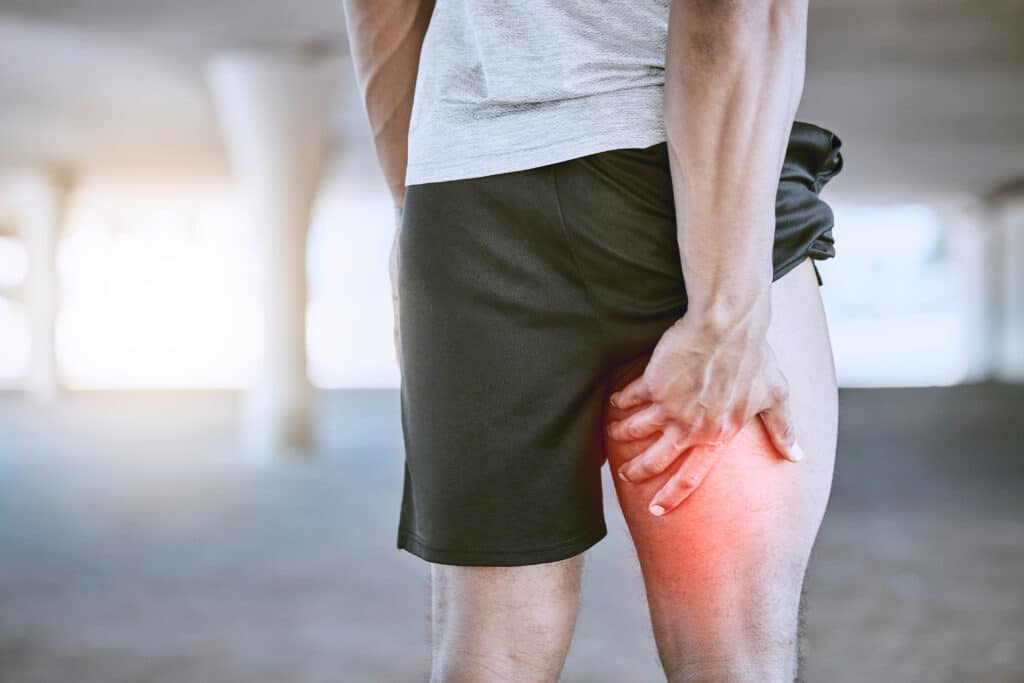

HIGH HAMSTRING PAIN
Pain deep under the glute or upper hamstring, often worse with sitting, hills, or longer running.
AT A GLANCE
Pain Area
Medical Name
Can you Run?
Typical Recovery
Common Onset
Can I keep running?
Some runners can continue modified running if symptoms stay manageable and the tendon is not significantly worse afterwards.
If pain becomes sharper, more reactive, or starts affecting walking, sitting, or daily movement more consistently, it usually means the tendon is not coping with the current load.
Typical recovery timeline
High hamstring tendon pain often takes 6 to 12 weeks or more to improve properly.
Long standing tendon irritation can take several months to fully rebuild, especially if the tendon has been repeatedly aggravated before treatment starts.
COMMON SYMPTOMS
- Pain deep under the glute
- Pain at the top of the hamstring
- Pain with:
- running
- hills
- speed work
- longer sitting
- Tightness or pulling through the upper hamstring
- Pain that lingers after harder running
- Tenderness near the sitting bone
WHAT’S ACTUALLY GOING ON?
Proximal Hamstring Tendinopathy is irritation of the hamstring tendon where it attaches high up near the sitting bone.
In runners, this tendon often becomes overloaded through repeated pulling and compression, especially during hills, speed work, or longer stride patterns.
Rather than being one sudden injury, this is usually a tendon that has gradually become more reactive and less tolerant of load over time.
CAN YOU STILL RUN WITH IT?
Sometimes, yes, but only if symptoms stay controlled and the tendon is not becoming progressively more irritated. Easy flat running is usually tolerated better than hills, speed sessions, or longer harder efforts. If sitting becomes increasingly painful or the tendon starts reacting more aggressively after running, it usually means the load needs to be reduced more clearly. Things that often need adjusting:
01.
Weekly mileage
02.
Speed work
03.
Hills
04.
Long Runs
05.
Running Frequency
COMMON QUESTIONS
Does this sound like you?
This may sound familiar if:
- You feel pain deep under the glute when running
- Sitting for long periods becomes uncomfortable
- Hills or speed work flare it up quickly
- The upper hamstring feels tight or irritated afterwards
- The pain feels stubborn and slow to settle
- Stretching the hamstring aggressively often makes it angrier
A common clue is that this often feels more like a deep irritated tendon than a pulled muscle.
WHY DO RUNNERS GET THIS?
This usually happens when the upper hamstring tendon is repeatedly overloaded.
Common reasons include:
- increased hill running
- speed work
- longer stride patterns
- sudden increases in training load
- reduced glute or hamstring strength
- poor recovery between harder sessions
Often the tendon has been overloaded for quite a while before symptoms become impossible to ignore.
When should you get help?
It’s worth getting help if:
- sitting is becoming consistently painful
- symptoms keep returning
- the tendon is not improving with load changes
- running quality is starting to change
- you are struggling to rebuild training normally
Get help sooner if you have:
- sudden sharp pain
- bruising
- major weakness
- pain that rapidly worsens
- difficulty walking normally
Tendons high up in the hamstring often become stubborn when runners keep trying to stretch aggressively or run through increasing pain.
HOW TO TREAT HIGH HAMSTRING PAIN
Have a look at Liesel's rehab plan to help improve your injury.